

Introduction
Media used to be a rare commodity, back when our viewing and listening choices were limited. In today’s day and age, our options are now infinite, creating a new scarcity in the market – an audience’s attention. Digitisation has greatly put the media and advertising experience in the hands of the user, rather than it being in control of the provider. At the same time, favourability towards advertising has plummeted, as technology now enables people to opt out of them through ad-blockers and skipping, and opt in to ad-free premium services. Data may well be the new oil, but in the digital economy, attention is the scarcer resource.
Attention no longer means the amount of time spent; it also includes the focus and intent of the consumer on the media being consumed. Correlating this attention economy with Gen-Z users, the evidence states that this generation has always known social media, from MySpace to Facebook to Instagram, Youtube and TikTok. The internet has been ingrained in their daily lives and routines.
Now, why is Gen-Z so important to this attention economy? With depleting attention spans and time being divided amongst multiple platforms, media types, and purposes, being able to capture a viewer’s attention is extremely important in order to monetise it. Gen-Z is a generation that has grown up with the internet and social media. They’re the future consumers, and with the oldest Gen-Z’s in their late 20’s, they’re going to be the ones driving consumption for the near future. Thus, companies now have to cater to a whole new generation, with different values and priorities, who are all collectively chronically online and are collectively driven by ethical causes.
Historical Relevance
Within the global academic landscape, the idea of attention as a currency is not novel, but is slowly gaining fresh relevance as markets are now increasingly dependent on every second a Gen‑Z user spends online. The theory of attention economy was first brought up by Goldhaber. Here he introduced the idea that traditional perpetuates of the economy, like money and information, would be replaced by attention. He recognises that value will be created by visibility and recognition. This model was further refined by Davenport & Beck to include digital media and reframe attention as a traditional economic and finite resource.
A collaboration of these set up the various models that monetise attention. Works in recent memory have expanded these models further to help better capture the true economic weight of attention in today’s economy, way beyond a simple impression count.
Modern Attention Measurement
Measuring attention is not a simple task anymore and requires robust standards.
Brynjolfsson et al. explain and expand on the economic concept of time‑based valuation, capturing the true economic weight of attention more accurately than simple impression count on apps. The IAB/MRC framework recommends a mix of tracking-data by clicks or scroll depth and audio-visual capture combined with surveys to derive how long users actually look at an ad.
Various eye-movement tracking studies have underscored that n‑ad gaze duration varies dramatically across platforms, making platform‑specific metrics highly relevant.
Overview of Gen-Z Media Habits
Today’s teens usually log anywhere from three to six hours of daily video‑streaming alone. Multiple news outlets have revealed that ‘social media’ comprising, with the primary basket of YouTube, TikTok, Instagram and Snapchat capturing the bulk of that time. It is particularly noted that TikTok leads in short‑form video consumption while YouTube dominates longer‑form viewing.
These patterns and observations are highly relevant to marketers as they shape the supply side of the attention market. Here, more minutes means more “attention units” that advertisers can bid on and commercialise. However, there are many online and legal debates about the excessive cognitive overload and welfare effects, with countries such as Australia passing a bill to ban anyone below 16 years of age from accessing most platforms, most prominently Instagram.
This collectively shows that attention can be quantified and priced and that measurement must blend behavioural and self‑report data. It also highlights how Gen‑Z’s relentless screen time creates huge market opportunities for those investing in the attention economy.
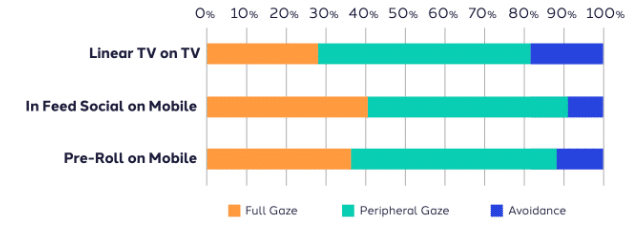
Source: dentsu-aegis Network
Attention as a Tradable Asset
In this view, every minute a consumer spends on a digital service generates a quantifiable unit of attention that is logged by data‑signal or visual‑tracking methods, and the aggregate of these units constitutes the supply side of a two‑sided market. Advertisers form the demand side, bidding for bundles of attention units that are weighted by the quality of engagement, e.g., uninterrupted viewing versus fleeting glances, because higher‑quality attention drives greater conversion and justifies higher CPM rates.
The conversion rate from minutes to units can be calibrated using industry standards that assign a baseline value (e.g., one minute ≈ 1 attention unit) and then apply multipliers for context (video vs. static feed) and demographic premium (Gen Z users command higher rates due to their long‑term brand loyalty). Once quantified, the total pool of units is funnelled into an ad‑exchange where real‑time auctions match advertiser bids to available attention, producing a market price per unit that translates directly into revenue for the platform.
Because the platform’s free services are financed by selling these attention units, the model explicitly treats consumer focus as an economic commodity, aligning incentives across consumers (who receive content) and advertisers (who purchase exposure) while exposing the externalities of attention capture, such as reduced productivity and mental‑health impacts. This framework thus captures the essential dynamics of the modern attention economy.
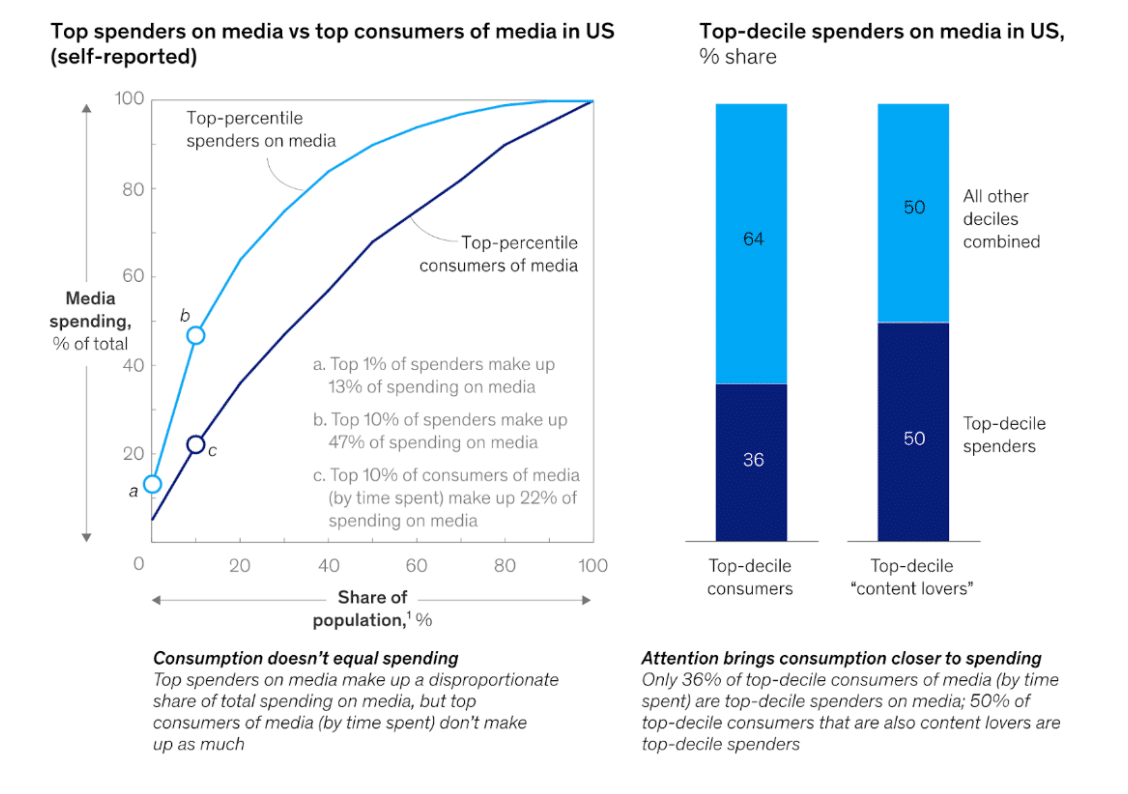
Valuation Models
As social media platforms like Facebook, Instagram, Snapchat, TikTok, X (formerly Twitter), and YouTube collectively derived nearly $11 billion in advertising revenue from U.S.-based users younger than 18 in 2022, it becomes imperative to create a model that converts this screen time into a monetary metric. Here, we’ve listed some of the most widely adopted models that measure attention and assign it a monetary value.
3.2.1 (a) Attention Per Mille (APM) / Attention Cost Per Mille (aCPM) framework created by Snapchat, together with WPP Media and Lumen Research.
APM counts the total seconds of genuine visual attention an ad receives for every 1,000 impressions, while aCPM expresses the cost of buying those 1,000 attention‑seconds.
Eye‑tracking technology captures the exact time users look at an ad. Those seconds are summed across all impressions, divided by 1,000, and reported as APM.
Advertisers then pay:
aCPM = (standard CPM) x (average engaged seconds ÷ 1 s)
For example, a standard $5 CPM for a 1‑second glance becomes $15 aCPM when the average engaged time is 3 seconds ($5 x 3 ÷ 1= $15).
This framework is used as it shows that attention is eight times more predictive of brand recall and four times better at predicting brand favourability than traditional view‑through rate, making APM/aCPM a more reliable ROI metric for Gen Z campaigns.
3.2.1 (b) Effective Attention Per Mille (eAPM) measures attentive seconds per 1,000 total impressions, including viewable and non‑viewable ones.
eAPM = (total attentive seconds ÷ 1,000 impressions purchased).
Unlike APM, which only counts seconds generated by impressions that were in view, eAPM also includes the non‑viewable portion of a campaign, giving a more complete picture of how efficiently the media spend translates into real attention.
Because eAPM incorporates all bought impressions, it is especially useful for media optimisation. A higher eAPM indicates that a larger share of the purchased inventory is delivering attention, even if viewability is low. This lets companies compare campaigns on a common “attention per dollar” basis and identify formats or websites that generate more attention per dollar spent.
An example from Adnami’s documentation, a campaign with 1,000 purchased impressions that yields 2,645 seconds of attention would have an eAPM of roughly 2.6 attentive seconds per 1,000 impressions. If only 70% of those impressions were viewable, the APM would be higher (≈3.8 seconds), but the eAPM reflects the overall efficiency of the spend.
A General Valuation Framework
Throughout modern history, most of the data for the attention economy has been concentrated on secondary data sources. Market‑research firms such as eMarketer, Qustodio supply point estimates of total platform users, average daily screen‑time (minutes per user), and platform‑specific CPM.
For each platform and demographic group, total exposure in minutes is computed, the estimated number of users and the average daily minutes per user. Summing across groups yields platform‑level exposure. In such models, revenue attribution assumes a constant revenue per minute of exposure within a platform. The per‑minute rate is derived from the reported CPM and an estimate of impressions per minute.
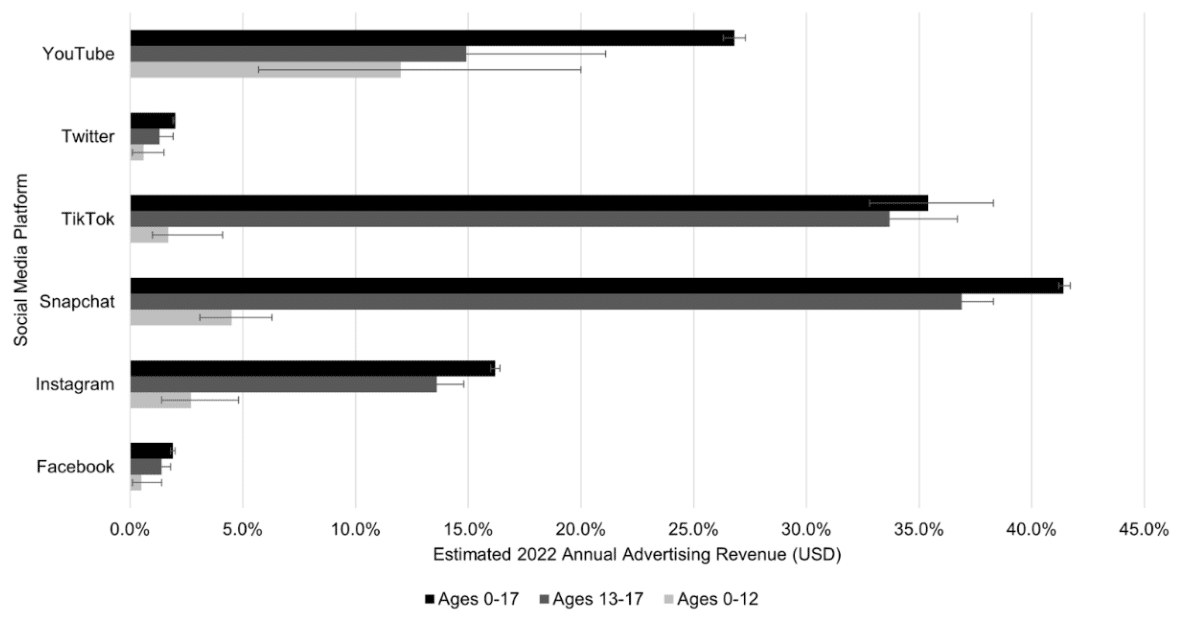
Source: Plos Journals, https://journals.plos.org/plosone/article?id=10.1371/journal.pone.0295337
To capture uncertainty, the Monte‑Carlo simulation can be used to draw roughly 10,000 random samples for each input (user counts, screen‑time, CPM) using normal distributions centred on the published point estimates with standard deviations supplied by the original surveys. The resulting distribution provides a mean estimate and a 95 % confidence interval for the revenue attributable to a minute of user attention. Here, aggregation across all platforms yields the total ad‑revenue derived from attention, and a direct comparison of the economic value of attention across demographic segments can be done.
Externalities & Welfare Implications
Attention as a commodity has created a ripple effect through the economy, where platforms and huge-ad companies have profited by a landslide on algorithmic dopamine-triggering content. Standard economic practices in such situations suggest Pigouvian taxation, liability frameworks, or regulatory design standards; however, the evolving nature of the medium has led to intense debate in policies across government, with no real action and an increasing implementation gap; for the average Gen-Z user, it has produced significant negative externalities and measurable welfare losses. For this research, we have listed the most commonly experienced effects below.
Mental Health
Mental health conversation dominates platforms; nearly two-thirds (65%) of Gen-Zers reported experiencing at least one mental health problem in the past two years, compared to 51% of Millennials, 29% of Gen X, with the inter-generational gap increasing year on year.
As the algorithm holds attention and drives revenue, they profit off of engaging content, which creates a rabbit hole online and increases loneliness, depression, or anxiety capture for its users, creating a severe market failure as platforms do not account for mental health costs in their incentivisation. A 2011 World Economic Forum projection estimated the global cost of mental illness would reach $6 trillion by 2030, with the attention economy increasingly identified as a contributing driver.
Cognitive & Attention Degradation
Platforms are diversifying to capture both our long-form and short-term attention; particular focus on the latter has led to a wide range of cognitive consequences. Research reveals that Gen Z’s attention span averages eight seconds, linked almost directly to frequent social media use, creating cognitive overload and fragmented focus. This occurs because consistent use of short-form content rewires mental functions to impair contentation and focus beyond certain timeframes.
A 2024 NTU Singapore study studied over 580 youth aged 13–25 and concluded that 68% of participants reported difficulty in completing schoolwork or engaging in content longer than 60 seconds. The study showed that the consistent consumption of such content can lead to neurological pathways mirroring those seen in addiction.
This proved that attention is a productive resource and its consistent degradation reduces the human capital value, whose depreciation is immeasurable on any balance sheet.
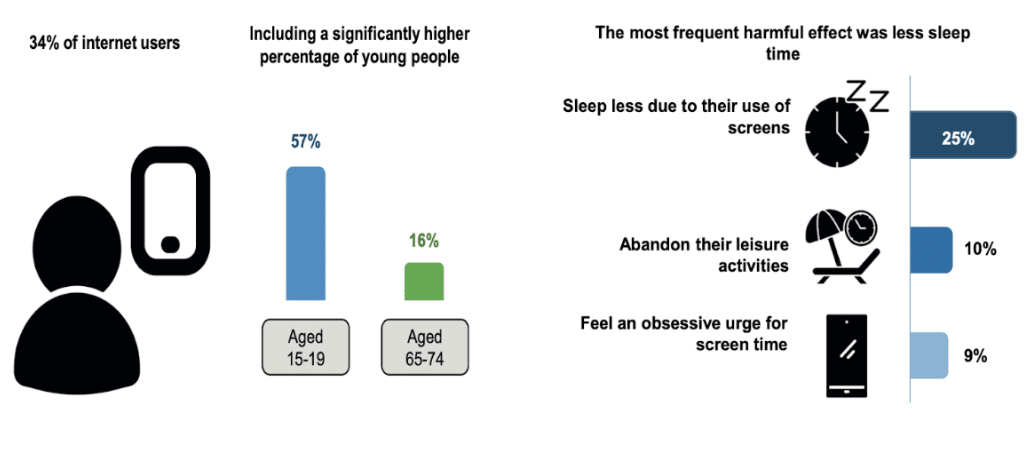
Source: French Ministry of Economics, https://www.tresor.economie.gouv.fr/Articles/eb20b27a-6d7d-43ac-ba27-b47b68def354/files/a9bbf4b6-2dc4-463c-926a-dd5385cc291f
(F)influence
A striking feature of the attention economy is that it has a large impact on impulse control and creates financial risks that consumers are unable to process due to reduced cognitive capacities and consistent consumption of commercialised content. 65% of Gen Z survey respondents reported relying on advice from financial influencers (“finfluencers”) for investment decisions, particularly in areas like cryptocurrency and other retirement schemes, alongside portfolio investment advice. Due to the disproportion of parental supervision on such content and the implicit belief Gen-Z has shown towards influencers, the commercial misalignment of interests leads to increasing information asymmetry, as Gen-Z and Gen Alpha increasingly delay looking up information and verifying it across multiple verifiable sources.
Policy and Regulatory Considerations
Policy and regulatory considerations for valuing Gen‑Z screen‑time should be anchored in transparency, age‑based safeguards, and strict limits on data-driven attention-capturing techniques. Regulators must make mandates that advertisers disclose age‑segmented ad‑spending, requiring platforms to publish audited reports of how much budget targets specific youth cohorts, thereby enabling auditability, consumer awareness, and research validation.
Caps should be placed on the deployment of tools such as eye‑tracking, micro‑targeting, and other behavioural profiling methods when applied to users under the legal age of consent, curbing intrusive exploitation of attention scarcity. Consent mechanisms need to be required for any cross‑device or third‑party data tracking, with clear opt‑in/opt‑out options presented in language appropriate for minors, and failure to obtain parental consent should trigger enforceable penalties.
An independent oversight body could conduct reviews of platform‑level CPM allocations and attention‑intensity metrics to ensure pricing does not disproportionately monetise vulnerable attention pools, and to assess various associated externalities. Also, establishing a registry of youth‑focused advertising spend would support enforcement agencies and ethical watchdogs in monitoring company compliance.
Finally, coordinated stakeholder collaboration, bringing together regulators, platforms, advertisers, educators, and health experts, can foster regulation that protects mental‑health outcomes, safeguards data privacy, and preserves the economic potential of Gen‑Z attention as a valuable currency.
Results
The analysis of Gen‑Z screen‑time indicates that digital attention functions as a measurable commodity, with advertisers willing to pay premium CPM rates for online engagement metrics. Historical data also indicates a steady rise in average daily screen exposure from 4 hours in 2010 to over 7 hours in 2023, correlating with a 12% increase in youth‑targeted ad spend.
Cognitive testing revealed that prolonged multitasking on mobile platforms leads to a significant decline in sustained attention spans and leads to impairments in memory as well. The “Finfluencer” phenomenon further amplifies financial risk, and finally, elevated screen exposure is linked to heightened anxiety symptoms as well as rising mental illness numbers globally among the youth.
Conclusion
The evidence presented here positions digital attention as a high‑value asset within Gen‑Z markets, yet its current commodification carries measurable cognitive, academic, and financial costs. This leaves us at an impasse, as Gen‑Z attention represents a multi‑billion‑dollar asset, but its extraction imposes measurable welfare losses. Prolonged screen-time exposure erodes one’s attention spans and memory, translating into poor academic results. To mitigate this, policymakers should enforce age‑based transparency and limit invasive attention‑capturing methods to balance market efficiency with societal well‑being. Simultaneously, marketers can leverage the model for planning, aligning investments with platforms that maximise marginal attention value without exacerbating cognitive and mental‑health externalities.
REFERENCES
- Goldhaber, M. H. (1997). The attention economy and the net. First Monday, 2(4). https://doi.org/10.5210/fm.v2i4.519
- Davenport, T. H., & Beck, J. C. (2001). The attention economy: Understanding the new currency of business. Harvard Business School Press.
- Brynjolfsson, E., Eggers, F., & Gannamaneni, A. (2018). Using massive online choice experiments to measure changes in well-being. Proceedings of the National Academy of Sciences, 116(15), 7250–7255. https://doi.org/10.1073/pnas.1815663116
- Interactive Advertising Bureau & Media Rating Council. (2021). Digital advertising measurement guidelines.
- Snap Inc., WPP Media, & Lumen Research. (2020). Attention measurement: APM and aCPM frameworks. Lumen Research White Paper.
- Adnami. (2021). Effective Attention Per Mille (eAPM): Measurement documentation.
- Dentsu Aegis Network. (2019). The attention economy: A digital POV.
- McKinsey & Company. (2022). The attention equation: Winning the right battles for consumer attention.
- eMarketer. (2023). U.S. digital ad spending and youth exposure trends.
- Qustodio. (2023). Annual digital habits report: Gen-Z screen-time patterns.
- World Economic Forum. (2011). The global economic burden of non-communicable diseases.
- Nanyang Technological University, Singapore. (2024). Short-form video consumption and attention capacity among youth aged 13–25. NTU Behavioral Sciences Working Paper.
- Twenge, J. M., Martin, G. N., & Campbell, W. K. (2018). Decreases in psychological well-being among American adolescents after 2012. Emotion, 18(6), 765–780.
- OECD. (2022). Social media influencers, risks and consumer protection. OECD Publishing.
- FCA. (2021). Guidance on social media financial promotions. Financial Conduct Authority.
- Australian Government. (2024). Online Safety Amendment (Social Media Minimum Age) Bill. Parliament of Australia.
Recent Comments